---
title: Elasticsearch Ingestion
description: The Elasticsearch integration consists of two primary exporters that work together to maintain both lexical and semantic search indices: ElasticsearchLexicalExporter...
url: https://docs-v3-preview.elastic.dev/elastic/docs-builder/pull/3809/development/ingest
products:
- Elastic Docs Builder
---
# Elasticsearch Ingestion
Old development note — likely to be deleted or substantially rewritten.
## Elasticsearch Integration
The Elasticsearch integration consists of two primary exporters that work together to maintain both lexical and semantic search indices:
1. **ElasticsearchLexicalExporter** - Handles traditional full-text search indexing with hash-based change detection
2. **ElasticsearchSemanticExporter** - Manages semantic search indices using inference models for vector embeddings
These exporters are coordinated by the `ElasticsearchMarkdownExporter` class, which implements the `IMarkdownExporter` interface.
### Architecture Overview
Both exporters inherit from the abstract `ElasticsearchExporter` base class (defined in `src/Elastic.Markdown/Exporters/Elasticsearch/ElasticsearchExporter.cs`), which provides:
- **Channel-based ingestion**: Uses the `Elastic.Channels` library for high-performance buffered writes to Elasticsearch
- **Configurable concurrency**: Respects the `IndexNumThreads` setting to optimize throughput
- **Error handling**: Callbacks for export failures, server rejections, and retries
- **Progress tracking**: Logs buffer exports at configured intervals
### Hash-Based Change Detection
The lexical exporter implements an intelligent hash-based upsert strategy (`ScriptedHashBulkUpsertLookup`) that:
1. Computes a hash from the document's URL, body content, and headings
2. On index, compares the computed hash with the stored hash
3. If hashes match: Only updates the `batch_index_date` field (minimal overhead)
4. If hashes differ: Performs a full document update with new `last_updated` timestamp
This approach allows us to incrementally synchronize only the changed documents and deletions over to our semantic index.
### Shutdown and Synchronization Logic
The `StopAsync` method in `ElasticsearchMarkdownExporter` orchestrates a complex multi-phase synchronization sequence:
#### Phase 1: Drain and Finalize Lexical Index
```csharp
var stopped = await _lexicalChannel.StopAsync(ctx);
```
This calls the base `ElasticsearchExporter.StopAsync` method, which performs three critical operations:
1. **Drain in-flight exports** (`WaitForDrainAsync`): Waits for all buffered documents to be flushed to Elasticsearch
2. **Refresh the index** (`RefreshAsync`): Makes all indexed documents immediately searchable
3. **Apply aliases** (`ApplyAliasesAsync`): Swaps index aliases to point to the newly created time-stamped index
#### Phase 2: Semantic Index Bootstrap
```csharp
if (!semanticIndexHead.ApiCallDetails.HasSuccessfulStatusCode)
{
// Bootstrap semantic index if it doesn't exist
await _semanticChannel.Channel.BootstrapElasticsearchAsync(...);
await _transport.PutAsync(semanticIndex, ...);
await _semanticChannel.Channel.ApplyAliasesAsync(ctx);
}
```
If the semantic index doesn't exist yet, it's created and configured with the appropriate inference model settings.
#### Phase 3: Incremental Sync - Updates
```csharp
_reindex updates: '{SourceIndex}' => '{DestinationIndex}'
```
Uses Elasticsearch's `_reindex` API to copy **only changed documents** from the lexical index to the semantic index:
- **Query filter**: `last_updated >= _batchIndexDate`
- **Result**: Only documents that were actually modified (not just batch-tracked) are synced
- This triggers semantic embedding generation for new/changed content
#### Phase 4: Incremental Sync - Deletions
```csharp
_reindex deletions: '{SourceIndex}' => '{DestinationIndex}'
```
Uses `_reindex` with a script to propagate deletions:
- **Query filter**: `batch_index_date < _batchIndexDate` (documents not in current batch)
- **Script**: `ctx.op = "delete"` - converts reindex operations to deletions
- **Result**: Documents removed from the documentation are deleted from semantic index
#### Phase 5: Cleanup Lexical Index
```csharp
await DoDeleteByQuery(lexicalWriteAlias, ctx);
```
Removes stale documents from the lexical index using `_delete_by_query`:
- **Query filter**: `batch_index_date < _batchIndexDate`
- **Result**: Lexical index only contains documents from the current batch
### Task Monitoring
Both `DoReindex` and `DoDeleteByQuery` methods use Elasticsearch's task API to monitor long-running operations:
1. Submit the operation with `wait_for_completion=false` to get a task ID
2. Poll the `/_tasks/{taskId}` endpoint every 5 seconds
3. Log progress metrics: total documents, created, updated, deleted, batches, and elapsed time
4. Continue until `completed: true`
This provides real-time visibility into large-scale index operations without blocking the application.
### Index Naming Strategy
Both exporters use time-stamped index names with write aliases:
- **Lexical**: `{prefix}-lexical-{namespace}-{timestamp}` with alias `{prefix}-lexical-{namespace}`
- **Semantic**: `{prefix}-semantic-{namespace}-{timestamp}` with alias `{prefix}-semantic-{namespace}`
The `-latest` formatted alias (e.g., `...-{yyyy.MM.dd.HHmmss}`) is used as a write alias during the current indexing operation, then swapped to the read alias upon completion. This enables zero-downtime reindexing.
### Error Handling
The `StopAsync` sequence includes comprehensive error tracking:
- Failed drains, refreshes, or alias operations emit global errors via `IDiagnosticsCollector`
- The lexical channel stop must succeed (`stopped == true`) or an exception is thrown
- Task failures during reindex/delete operations are logged and recorded as global errors
This ensures that indexing problems are visible and prevent silent data corruption.
## Indexing Flow Visualization
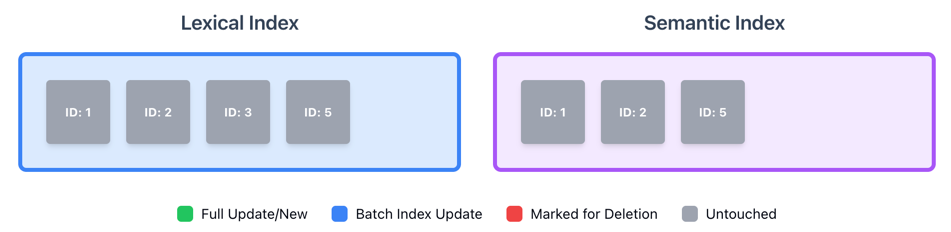
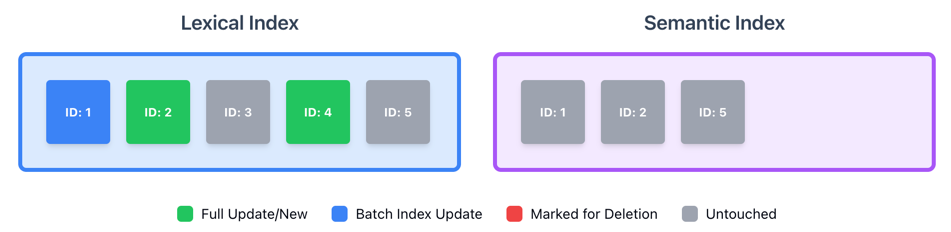
- ID 1: Hash matches → Only batch_index_date updated (blue)
- ID 2: Hash changed → Full upsert with new last_updated (green)
- ID 3: No incoming data → Untouched (gray)
- ID 4: New document → Insert (green)
- ID 5: Not included in current batch → Untouched (gray)
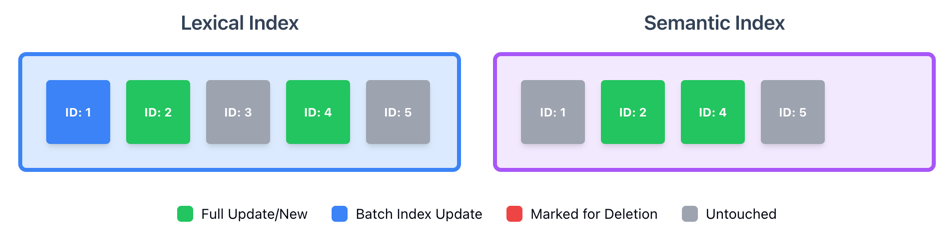
- Copy documents from Lexical Index where last_updated >= 2024-10-15
- Only IDs 2 and 4 synced (ID 1 has old last_updated date)
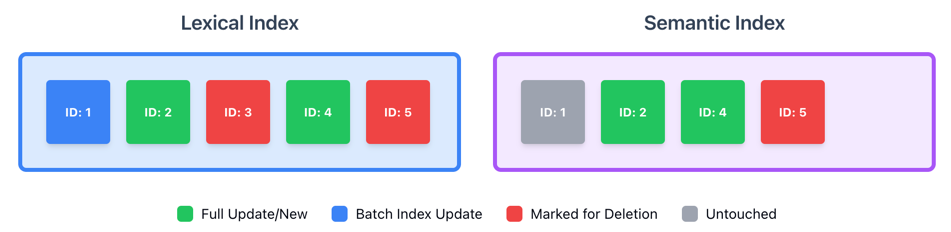
- Lexical Index: Mark IDs 3 and 5 (batch_index_date < 2024-10-15) as red
- Semantic Index: Sync deletion of ID 5 from Lexical Index, mark as red
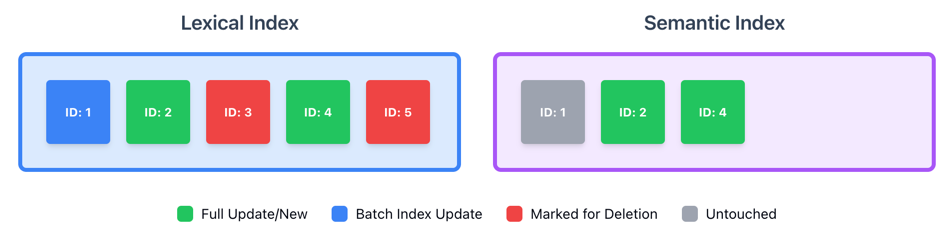
- Remove ID 5 from Semantic Index
- Lexical Index still has IDs 3 and 5 marked for deletion
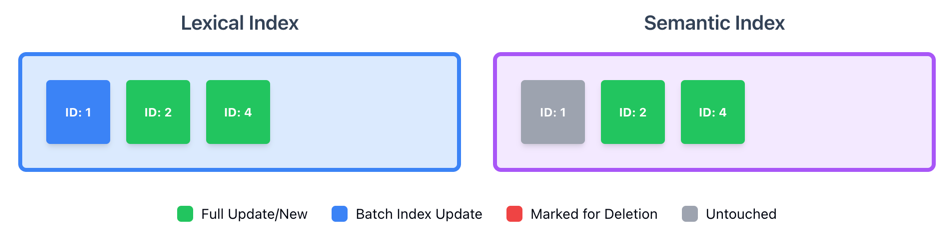
- Delete IDs 3 and 5 from Lexical Index
- Semantic Index remains as-is (batch_index_date not updated there)
- Both indexes now synchronized with same document IDs