---
title: Dashboard controls
description: Interactive filter controls for Kibana dashboards, including options lists, range sliders, time sliders, and ES|QL variable controls.
url: https://docs-v3-preview.elastic.dev/elastic/docs-content/pull/5664/explore-analyze/visualize/dashboard-controls
products:
- Kibana
applies_to:
- Elastic Cloud Serverless: Generally available
- Elastic Stack: Generally available
---
# Dashboard controls
**Controls** are interactive panels that you add to your dashboards to help viewers filter and display only the data they want to explore. Controls apply filters to relevant panels so viewers can focus on specific data segments without writing filtering queries.
## Control types
You can add three kinds of controls:
- **Control**: A filter based on a [data view](https://docs-v3-preview.elastic.dev/elastic/docs-content/pull/5664/explore-analyze/find-and-organize/data-views) field. When you create it, you choose one of two types:
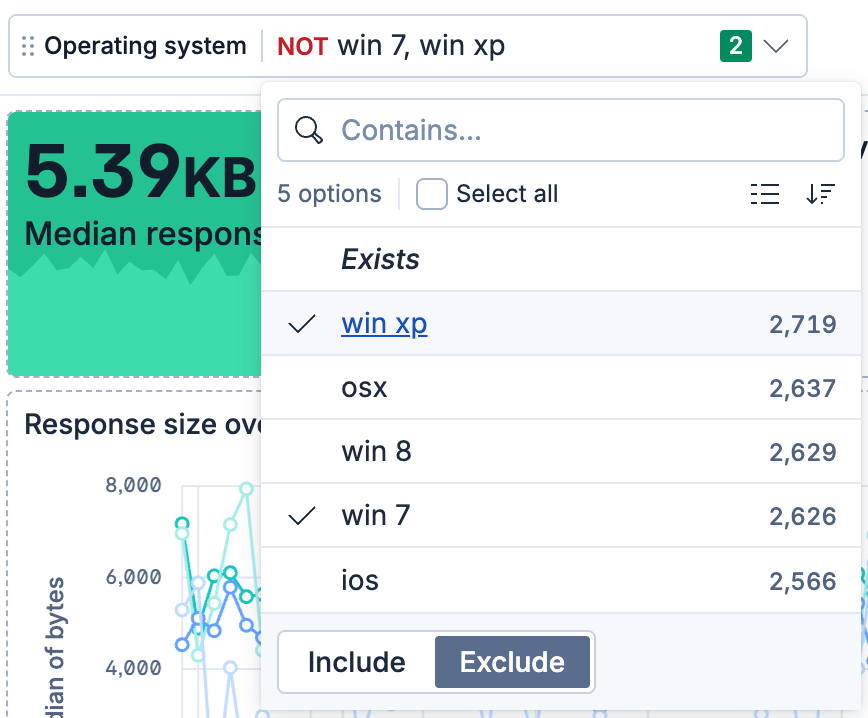
- **Options list**: A dropdown that filters data by one or more selected values. Use it for fields with a limited set of distinct values, such as categories, statuses, or hostnames.
For example, in the **[Logs] Web Traffic** dashboard from the sample web logs data, you can add an options list for the `machine.os.keyword` field to display only the logs generated from `osx` and `ios` operating systems.
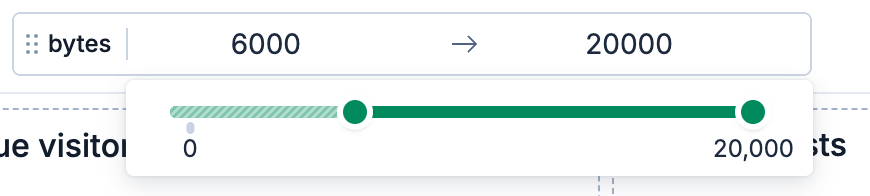
- **Range slider**: A slider that filters data within a specified range of values. Only compatible with numeric fields.
For example, in the **[Logs] Web Traffic** dashboard from the sample web logs data, you can add a range slider for the `hour_of_day` field to display only the log data from 9:00 AM to 5:00 PM.
- Elastic Cloud Serverless: Preview Elastic Stack: Preview since 9.0 **Variable control**: An ES|QL-powered control that binds to variables in ES|QL visualization queries, enabling dynamic filtering, grouping, and function selection.
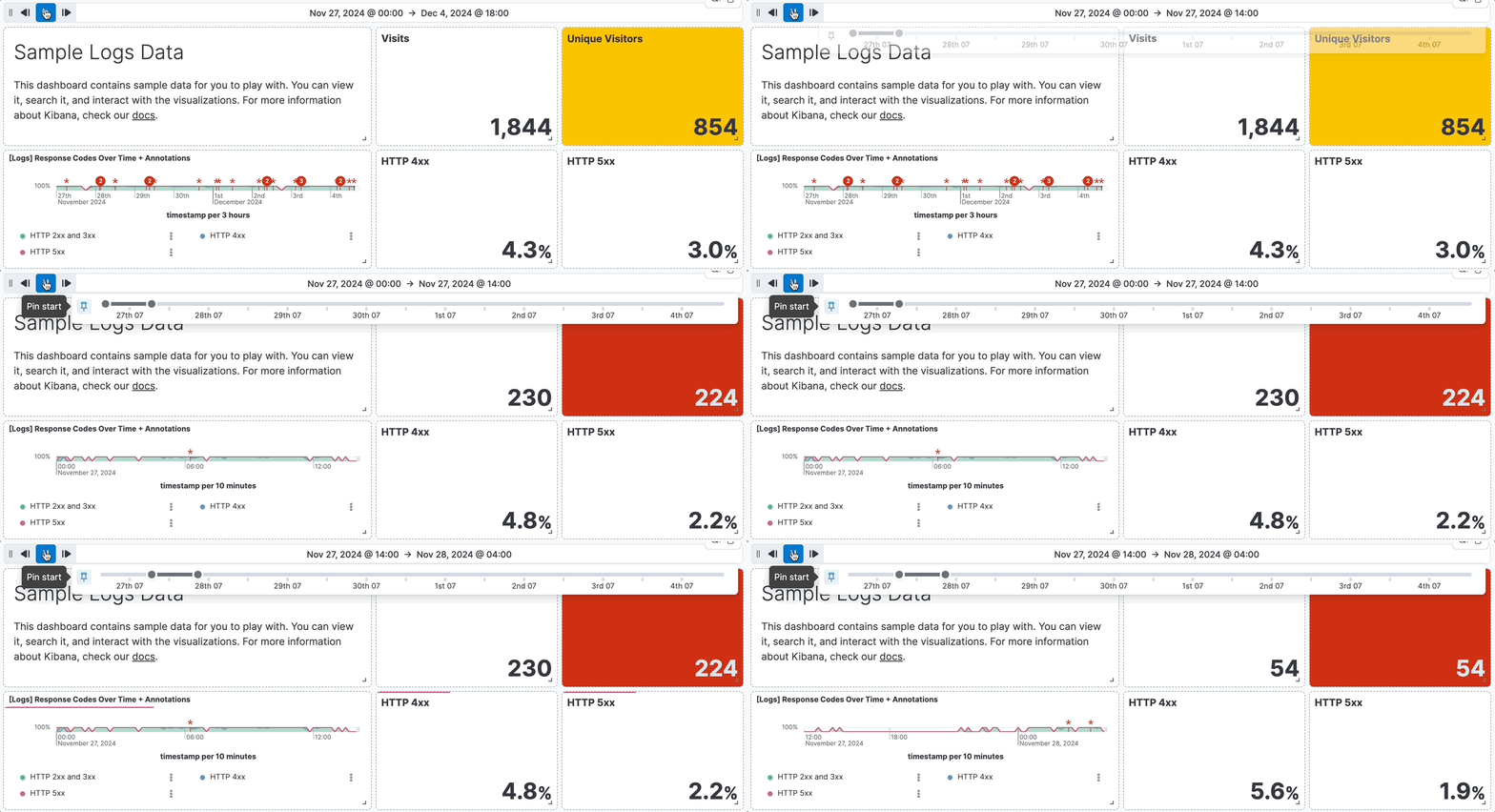
- **Time slider**: A time range slider that filters data within a specified time range. Advance the range backward and forward, or animate the data change across the range.
## How controls affect the dashboard
A control acts on the panels relevant to it, not the whole dashboard. And when a dashboard has several controls, their selections also narrow each other's options. What a given control affects depends on where you place it, its type, and the other controls on the dashboard.
### Pinned and unpinned controls
Where you place a control determines its reach:
- **Pinned** controls are placed at the top of the dashboard, stay visible as you scroll, and apply across the whole dashboard. New controls are pinned by default.
- Elastic Cloud Serverless: Generally available Elastic Stack: Generally available since 9.4 **Unpinned** controls are placed in the dashboard body like any other panel, and you can move, resize, and arrange them. They apply to every panel on the dashboard they're relevant for, unless you place one inside a [collapsible section](/elastic/docs-content/pull/5664/explore-analyze/dashboards/arrange-panels#collapsible-sections), where its filters apply only to the relevant panels in that section.
Elastic Cloud Serverless: Generally available Elastic Stack: Generally available since 9.4 You can pin or unpin a control at any time from its panel menu. For the steps, refer to [Manage Options list and Range slider controls](/elastic/docs-content/pull/5664/explore-analyze/visualize/add-controls#manage-controls).
### Scope by control type
Different control types target different panels:
- **Options list** and **Range slider** controls filter the panels that use the control's [data view](https://docs-v3-preview.elastic.dev/elastic/docs-content/pull/5664/explore-analyze/find-and-organize/data-views) field. Panels built on data that doesn't include that field aren't affected.
- A **Time slider** narrows the dashboard's [global time range](https://docs-v3-preview.elastic.dev/elastic/docs-content/pull/5664/explore-analyze/query-filter/filtering), so it affects only the panels that use time-based data.
- **Variable controls** affect only the ES|QL visualizations whose query references the control's variable. They don't filter other panels.
To see which panels a variable control affects, select its label while editing the dashboard. Its related panels are highlighted, and a variable control that no visualization uses shows a warning.
### Chaining between controls
Chaining links controls so that a selection in one narrows the options available in another. This keeps each control's choices relevant to the current selections, so viewers can drill down without landing on combinations that return no data. Options lists and range sliders chain with each other, and variable controls chain with each other, but the two groups stay independent: a selection in an options list or range slider doesn't change a variable control's options, and a variable control's selection doesn't change theirs.
- **Options list** and **Range slider** controls chain automatically: when a dashboard has more than one, each control's options reflect the selections in the others. This is on by default. To turn it off for a control, use the [**Use global filters** setting](https://docs-v3-preview.elastic.dev/elastic/docs-content/pull/5664/explore-analyze/visualize/dashboard-control-settings).
- **Variable controls** chain when one control's ES|QL query references another variable control's variable. For the steps, refer to [Chain variable controls](/elastic/docs-content/pull/5664/explore-analyze/visualize/add-variable-controls#chain-variable-controls).
## Next steps
- [Add controls to dashboards](https://docs-v3-preview.elastic.dev/elastic/docs-content/pull/5664/explore-analyze/visualize/add-controls): Add options list and range slider controls to your dashboards.
- [Add a time slider control](https://docs-v3-preview.elastic.dev/elastic/docs-content/pull/5664/explore-analyze/visualize/add-time-slider-controls): Add a control that filters time-based data across an adjustable range.
- [Add variable controls with ES|QL](https://docs-v3-preview.elastic.dev/elastic/docs-content/pull/5664/explore-analyze/visualize/add-variable-controls): Create ES|QL-powered controls for dynamic filtering and chaining.
- [Dashboard control settings](https://docs-v3-preview.elastic.dev/elastic/docs-content/pull/5664/explore-analyze/visualize/dashboard-control-settings): Reference for all available control settings per type and version.