---
title: Google Gemini connector and action
description: The Google Gemini connector uses axios to send a POST request to Google Gemini. You can create connectors in Stack Management > Connectors. For example:...
url: https://docs-v3-preview.elastic.dev/elastic/kibana/pull/280898/reference/connectors-kibana/gemini-action-type
products:
- Kibana
applies_to:
- Elastic Cloud Serverless: Deprecated
- Elastic Stack: Planned for deprecation
---
# Google Gemini connector and action
The Google Gemini connector uses [axios](https://github.com/axios/axios) to send a POST request to Google Gemini.
This connector is deprecated and is being progressively removed from the create connector UI. Existing connectors and their rule actions continue to work.For new AI integrations, use Elasticsearch inference endpoints. Migrate existing LLM connectors and related rule actions before the future removal.
## Create connectors in Kibana
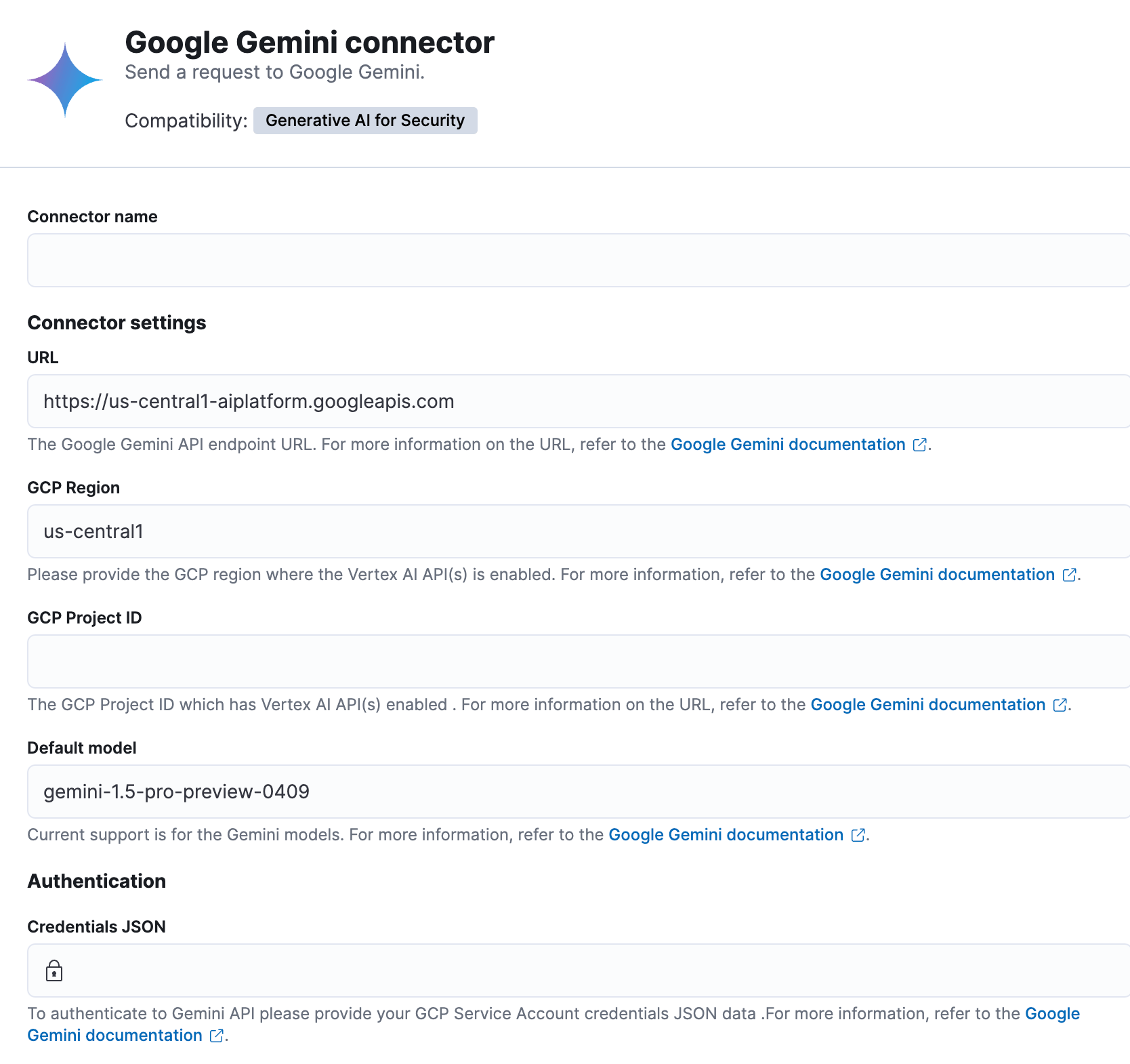
You can create connectors in **Stack Management > Connectors**. For example:
### Connector configuration
Google Gemini connectors have the following configuration properties:
The name of the connector.
The Google Gemini request URL.
The project which has Vertex AI endpoint enabled.
The GCP region where the Vertex AI endpoint enabled.
The GAI model for Google Gemini to use. Current support is for the Google Gemini models.
- Elastic Cloud Serverless: Generally available Defaults to `gemini-2.5-pro`.
- Elastic Stack: Generally available since 9.1 Defaults to `gemini-2.5-pro`.
- Elastic Stack: Generally available since 9.0 Defaults to `gemini-1.5-pro-002`.
The model can be set on a per request basis by including a "model" parameter alongside the request body.
The GCP service account JSON file for authentication.
## Test connectors
You can test connectors as you're creating or editing the connector in Kibana. For example:
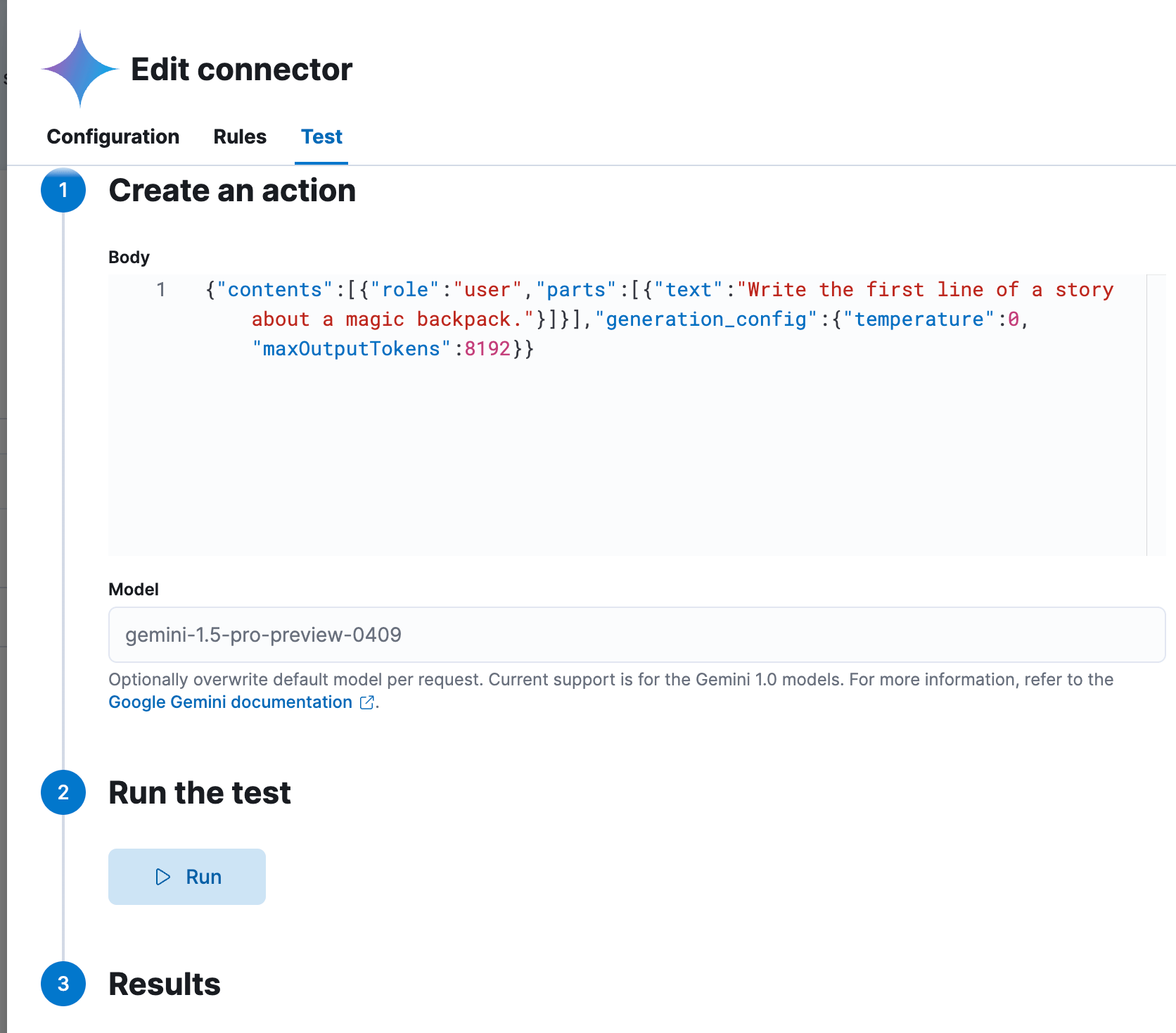
The Google Gemini actions have the following configuration properties.
A stringified JSON payload sent to the Google Gemini invoke model API. For example:
```text
{
body: JSON.stringify({
contents: [{
role: user,
parts: [{ text: 'Hello world!' }]
}],
generation_config: {
temperature: 0,
maxOutputTokens: 8192
}
})
}
```
An optional string that overwrites the connector's default model.
## Connector networking configuration
Use the [Action configuration settings](/elastic/kibana/pull/280898/reference/configuration-reference/alerting-settings#action-settings) to customize connector networking configurations, such as proxies, certificates, or TLS settings. You can set configurations that apply to all your connectors or use `xpack.actions.customHostSettings` to set per-host configurations.