ES|QL tools
ES|QL query tools enable you to create parameterized queries that execute directly against your Elasticsearch data. These custom tools provide precise control over data retrieval through templated ES|QL statements.
Use custom ES|QL tools when:
- You need precise control over the query logic
- Your use case involves repeatable analytical patterns
- You want to expose specific, parameterized queries to agents
- Results should be in a predictable tabular format
- You have well-defined data retrieval requirements
- Execute pre-defined ES|QL queries with dynamic parameters
- Support typed parameters
- Return results in tabular format for structured data analysis
- Ideal for repeatable analytical queries with variable inputs
ES|QL tools support the following parameter types:
- String types:
text,keyword - Numeric types:
long,integer,double,float - Other types:
boolean,date,object,nested
Parameters can be configured as:
- Required: Must be provided by the agent when calling the tool
- Optional: Can be omitted; uses
nullif no default is specified
In your ES|QL query, reference parameters using the ?parameter_name syntax. The agent will automatically interpolate parameter values when executing the query.
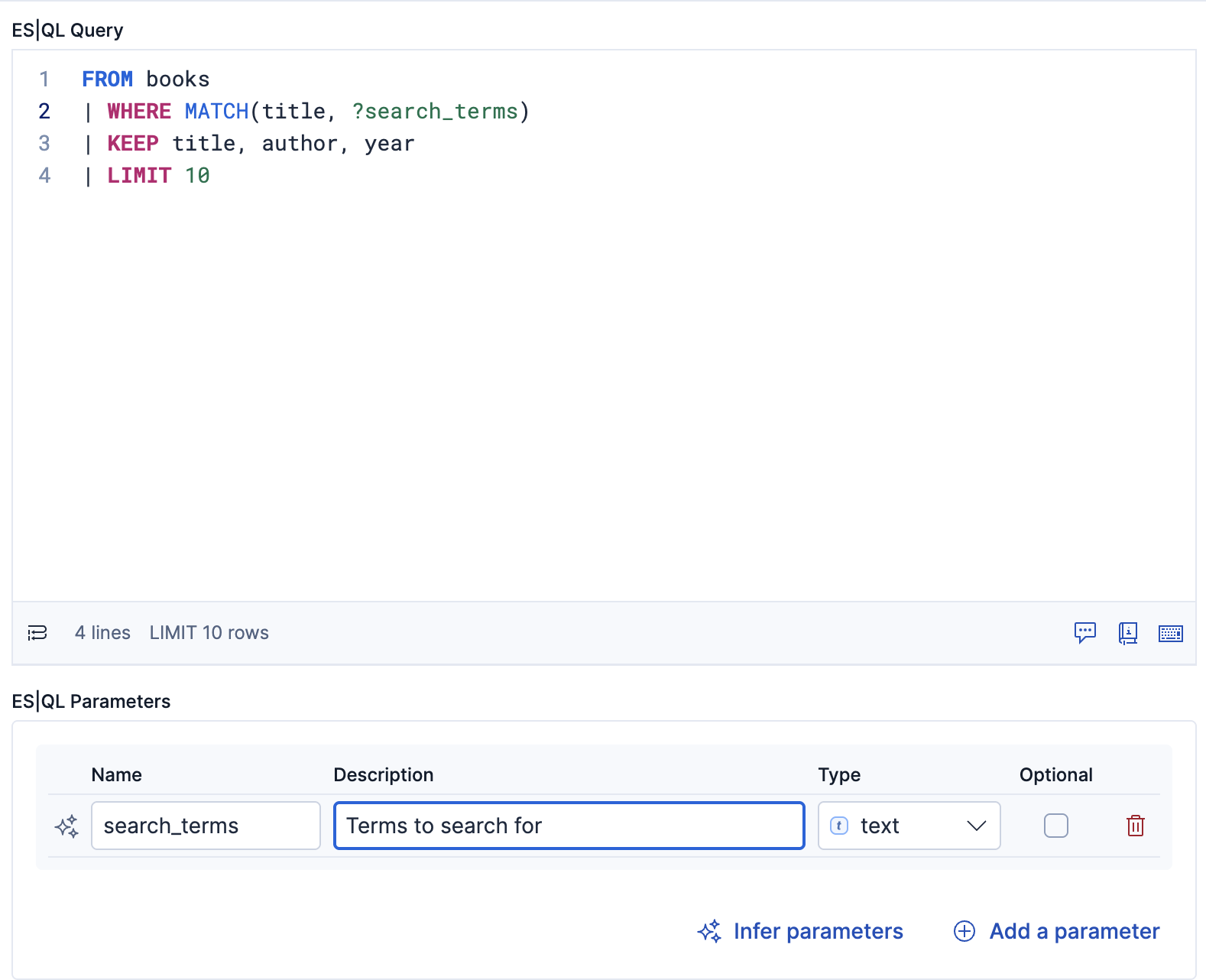
Here's an example ES|QL tool that searches for books using full-text search. ?search_terms is a named parameter that the agent will provide when executing the query.
FROM books
| WHERE MATCH(title, ?search_terms)
| KEEP title, author, year
| LIMIT 10
You can ask the LLM to infer the parameters for the query or add them manually.
- Include
LIMITclauses: Prevent returning excessive results by setting reasonable limits - Use meaningful parameter names: Choose names that clearly indicate what the parameter represents (e.g.,
start_dateinstead ofdate1) - Define parameter types: Ensure parameters have the correct type to avoid runtime errors
- Provide clear descriptions: Help agents understand when and how to use each parameter
If queries are slow or failing, you might be retrieving more data than the LLM can process. Refer to Context length exceeded for tips on diagnosing and resolving these issues.
ES|QL tools are subject to the current limitations of the ES|QL language itself. For more information, refer to ES|QL tool limitations.
To learn more about the language, refer to the ES|QL docs.