Elastic Cloud Managed OTLP Endpoint (mOTLP)
The Elastic Cloud Managed OTLP Endpoint allows you to send OpenTelemetry data directly to Elastic Cloud using the OTLP protocol.
The endpoint provides a resilient ingestion layer that works seamlessly with serverless autoscaling and offloads ingestion processing from Elastic Cloud Hosted clusters.
The Elastic Cloud Managed OTLP Endpoint endpoint is not available for Elastic self-managed, ECE, or ECK clusters. To send OTLP data to any of these cluster types, deploy and expose an OTLP-compatible endpoint using the EDOT Collector as a gateway.
To use the Elastic Cloud Elastic Cloud Managed OTLP Endpoint you need the following:
- An Elastic Cloud Serverless project or an Elastic Cloud Hosted (ECH) deployment.
- An OTLP-compliant shipper capable of forwarding logs, metrics, or traces in OTLP format. This can include:
- OpenTelemetry Collector (EDOT, Contrib, or other distributions)
- OpenTelemetry SDKs (EDOT, upstream, or other distributions)
- EDOT Cloud Forwarder
- Any other forwarder that supports the OTLP protocol.
You don't need APM Server when ingesting data through the Managed OTLP Endpoint. The APM integration (.apm endpoint) is a legacy ingest path that translates OTLP telemetry to ECS, whereas Elastic Cloud Managed OTLP Endpoint natively ingests OTLP data.
To send data to Elastic through the Elastic Cloud Managed OTLP Endpoint, follow the Send data to the Elastic Cloud Managed OTLP Endpoint quickstart.
To retrieve your Elastic Cloud Managed OTLP Endpoint endpoint address and API key, follow these steps:
- In Elastic Cloud, create an Observability project or open an existing one.
- Go to Add data, select Applications and then select OpenTelemetry.
- Copy the endpoint and authentication headers values.
Alternatively, you can retrieve the endpoint from the Manage project page and create an API key manually from the API keys page.
- Log in to the Elastic Cloud Console.
- From the home page, find your deployment in Hosted deployments, and select Manage. Or, on the Hosted deployments page, select your deployment.
- In the Application endpoints, cluster and component IDs section, select Managed OTLP.
- Copy the public endpoint value.
To configure OpenTelemetry SDKs to send data directly to the Elastic Cloud Managed OTLP Endpoint, set the OTEL_EXPORTER_OTLP_ENDPOINT and OTEL_EXPORTER_OTLP_HEADERS environment variables.
For example:
export OTEL_EXPORTER_OTLP_ENDPOINT="https://<motlp-endpoint>"
export OTEL_EXPORTER_OTLP_HEADERS="Authorization=ApiKey <key>"
You can route logs to dedicated datasets by setting the data_stream.dataset attribute on the log record. This attribute is used to route the log to the corresponding dataset.
For example, if you want to route the EDOT Cloud Forwarder logs to custom datasets, you can add the following attributes to the log records:
processors:
  transform:
    log_statements:
      - set(log.attributes["data_stream.dataset"], "aws.cloudtrail") where log.attributes["aws.cloudtrail.event_id"] != nil
You can also set the OTEL_RESOURCE_ATTRIBUTES environment variable to set the data_stream.dataset attribute for all logs. For example:
export OTEL_RESOURCE_ATTRIBUTES="data_stream.dataset=app.orders"
This diagram shows data ingest using Elastic Distribution of OpenTelemetry and the Elastic Cloud Managed OTLP Endpoint:
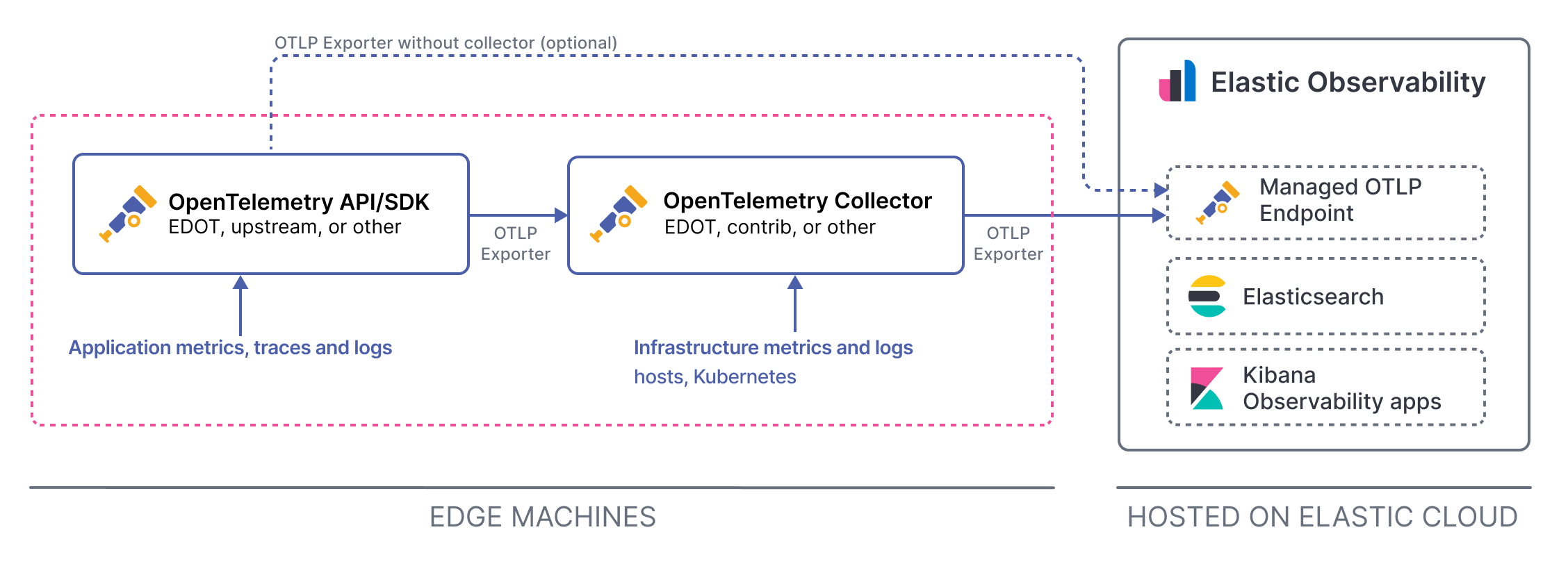
Telemetry is stored in Elastic in OTLP format, preserving resource attributes and original semantic conventions. If no specific dataset or namespace is provided, telemetry would be routed to the generic data streams: traces-generic.otel-default, metrics-generic.otel-default, and logs-generic.otel-default.
For a detailed comparison of how OTel data streams differ from classic Elastic APM data streams, refer to OTel data streams compared to classic APM.
The Elastic Cloud Managed OTLP Endpoint endpoint is built for high availability, but some failures can still prevent telemetry events from being written to your Elasticsearch cluster (for example, ingest pipeline errors or mapping conflicts).
To protect data in these cases, Elastic Cloud Managed OTLP Endpoint uses the Failure store. For Elastic Cloud Managed OTLP Endpoint data streams, the failure store is always enabled.
When indexing fails, the original documents are written to a dedicated failure index instead of being dropped. This keeps ingestion resilient and gives you a recovery path for partial or failed sends.
You can inspect and triage these documents from Data Set Quality. Refer to Data set quality.
The following limitations apply when using the Elastic Cloud Managed OTLP Endpoint:
- Universal Profiling is not available.
- Only supports histograms with delta temporality. Cumulative histograms are dropped.
- Latency distributions based on histogram values have limited precision due to the fixed boundaries of explicit bucket histograms.
- Tail-based sampling (TBS) is not available. The Elastic Cloud Managed OTLP Endpoint does not provide centralized hosted sampling. If you need tail-based sampling, configure it on the edge using the Tail Sampling Processor in your EDOT or OpenTelemetry Collector before sending data to the endpoint.
- In Elastic Cloud Hosted deployments:
- IP filters do not apply to the managed endpoint.
- The endpoint is not available over a private connection. When private connectivity is configured, the public managed endpoint is still available.
For more information on billing, refer to Elastic Cloud pricing.