Monitor rule executions
Detection rules only protect your environment when they run reliably. This page helps you confirm rules are running and troubleshoot when they're not.
| You want to | Where to go |
|---|---|
| Check if a rule succeeded, failed, or has warnings | Rule execution status (Rules table) |
| Get a summary of rule execution details and access individual rules | Rule Monitoring tab |
| Review a specific rule's run history | Execution results (rule details page) |
| Fill gaps from missed rule runs | Fill rule execution gaps |
| Run a rule manually for a specific time range | Run rules manually |
| View rule performance metrics in a dashboard | Detection rule monitoring dashboard |
| Investigate missing alerts | Troubleshoot missing alerts |
The Last response column in the Rules table displays the current status of each rule, based on the most recent attempt to run:
- Succeeded: The rule completed its defined search. This doesn't necessarily mean it generated an alert, just that it ran without error.
- Failed: The rule encountered an error that prevented it from running. For example, a machine learning rule whose corresponding machine learning job wasn't running.
- Warning: Nothing prevented the rule from running, but it might have returned unexpected results. For example, a custom query rule tried to search an index pattern that couldn't be found in Elasticsearch.
For machine learning rules, an indicator icon also appears in this column if a required machine learning job isn't running. Select the icon to list the affected jobs, then select Visit rule details page to investigate to open the rule's details page, where you can start the machine learning job.
To view a summary of all rule executions (including the most recent failures, execution times, and gaps), select the Rule Monitoring tab on the Rules page. To access the tab, find Detection rules (SIEM) in the navigation menu or by using the global search field, then go to the Rule Monitoring tab.
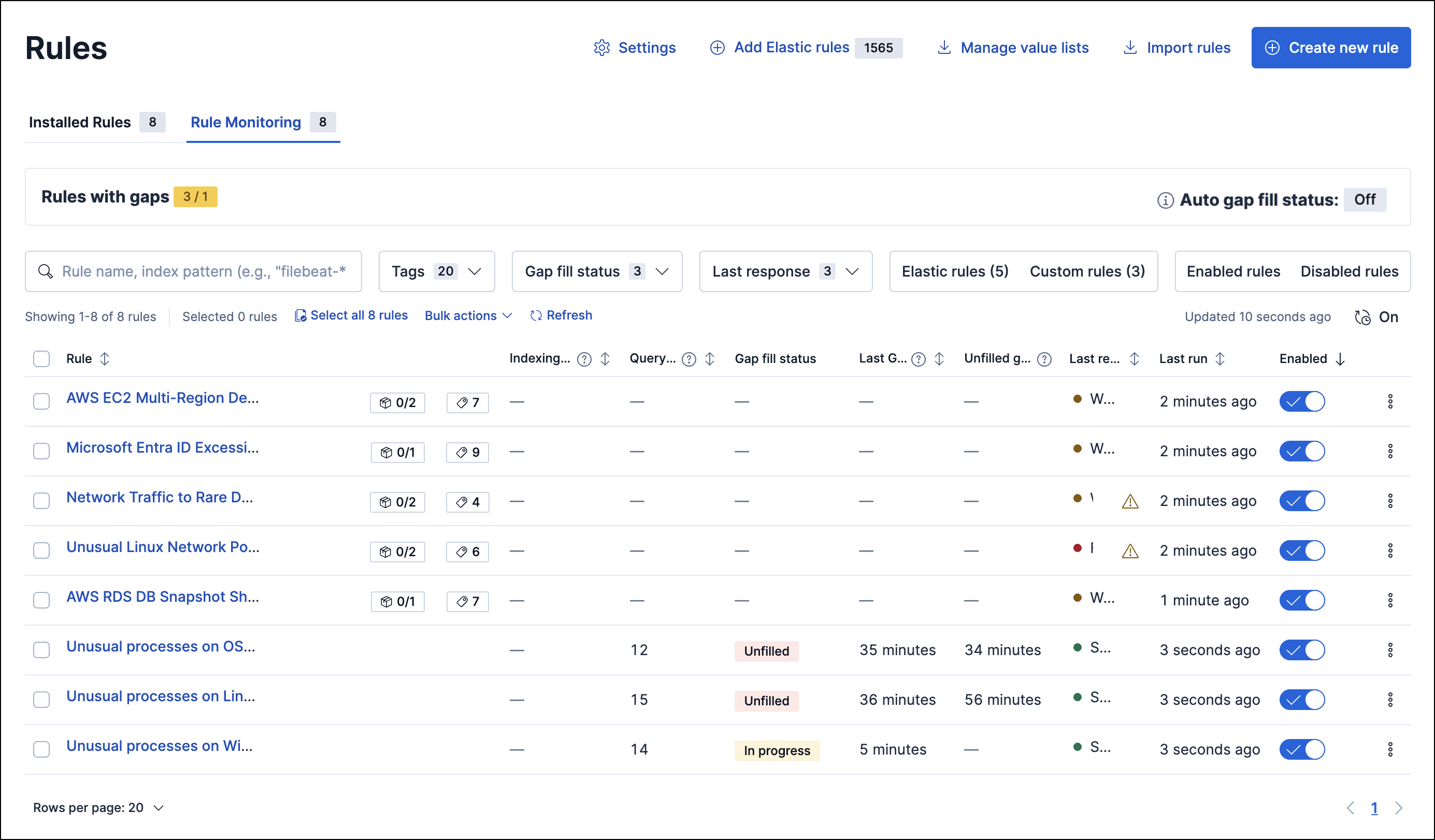
On the Rule Monitoring tab, you can sort and filter rules just like you can on the Installed Rules tab.
To sort the rules list, select any column header. To sort in descending order, select the column header again.
For detailed information on a rule, the alerts it generated, and associated errors, select its name in the table. This also allows you to perform the same actions available on the Installed Rules tab, such as modifying or deleting rules, activating or deactivating rules, exporting or importing rules, and duplicating prebuilt rules.
The Rule Monitoring tab also displays information about gaps in rule executions. Gaps are periods when a rule didn't run as scheduled.
Several columns provide gap data:
- Last Gap (if any): How long the most recent gap lasted.
- Unfilled gaps duration: Total duration of remaining unfilled or partially filled gaps. If a rule has no gaps, the column displays a dash (
––). -
Gap fill status: The status of the rule's gaps ( Unfilled,In progress, orFilled).
To learn how to find and fill gaps, refer to Fill rule execution gaps.
From the Execution results tab on a rule's details page, you can review how each run performed, monitor gaps, and check manual runs. To find this tab, select the rule's name to open its details, then scroll down.
Each detection rule execution is logged with status, timing, and how many alerts the run produced. The table helps you understand rule performance and troubleshoot failures.
You can hover over each column heading to display a tooltip about that column's data. Select a column heading to sort the table by that column.
| Column | Description |
|---|---|
| Status | Overall status of the execution. |
| Run type | Whether the run was a standard scheduled execution or a manual run. Manual includes manual runs that you start and runs generated by the automatic gap fill feature. |
| Timestamp | Date and time the rule execution started. |
| Execution duration | How long the rule took to run. |
| Alerts created | Number of new alerts generated during this execution. |
| Message | Outcome message from the execution (including warnings or errors when applicable). |
From the table, you can use the following row actions:
- Filter alerts by rule execution ID: Opens the Alerts table filtered to alerts from this execution. This control is disabled when the execution created no alerts (hover to see a tooltip).
- View details: Opens the execution details flyout for that run.
Use these controls to filter what appears in the table:
The Run type drop-down filters by rule execution type:
- Scheduled: Automatic, scheduled rule executions.
- Manual: Manually started runs and runs generated by the automatic gap fill feature.
The Status drop-down filters by rule execution status:
- Succeeded: The rule completed its defined search.
- Failed: The rule encountered an error that prevented it from running.
- Warning: The rule ran but might have returned unexpected results.
The date and time picker sets the time range of rule executions included in the table. This is separate from the global date and time picker at the top of the rule details page.
Additional timing, indexing, and gap details that were previously available through extra table columns and toggles are now shown in the execution details flyout.
The Execution results tab shows the run history in this layout. Each detection rule execution is logged, including the execution type, success or failure status, any warning or error messages, how long it took to search for data, create alerts, and complete. This can help you identify and troubleshoot a rule if it isn't behaving as expected (for example, if it isn't creating alerts or takes a long time to run).
You can hover over each column heading to display a tooltip about that column's data. Select a column heading to sort the table by that column. You can select the arrow at the end of a row to expand a long warning or error message.
Use these controls to filter what's included in the table:
The Run type drop-down filters by rule execution type:
- Scheduled: Automatic, scheduled rule executions.
- Manual: Manually started runs and runs that fill gaps.
The Status drop-down filters by rule execution status:
- Succeeded: The rule completed its defined search.
- Failed: The rule encountered an error that prevented it from running.
- Warning: The rule ran but might have returned unexpected results.
The date and time picker sets the time range of rule executions included in the table. This is separate from the global date and time picker at the top of the rule details page.
The Source event time range button toggles the display of data pertaining to the time range of manual runs.
The Show metrics columns toggle includes more or less data in the table, pertaining to the timing of each rule execution.
The Actions column allows you to show alerts generated from a given rule execution. Select the filter icon to create a global search filter based on the rule execution's ID value. This replaces any previously applied filters, changes the global date and time range to 24 hours before and after the rule execution, and displays a confirmation notification. You can revert this action by selecting Restore previous filters in the notification.
The execution details flyout displays additional timing, indexing, and gap details for the selected run. Use it to get a better understanding of that run, including errors and warnings, the number of candidate detections that became stored alerts, which indices were searched, and more. To open the execution details flyout, select View details on a row in the Execution log table.
These flyout metrics are stored only for executions logged on Elastic Stack 9.4 or later, and for Elastic Cloud Serverless projects after the same data began to be persisted. Executions logged on older versions (for example Elastic Stack 9.3 or earlier) might have blank fields in the flyout because those values were not recorded when the run was logged.
| Field | Description | How to use |
|---|---|---|
| Message | Whether the run completed successfully, plus errors or warnings such as index or query issues. | When a run failed or shows a warning, read this field before timing or alert counts. |
| Field | Description | How to use |
|---|---|---|
| Source event time range | Shown when this run targeted a defined source window, such as a manual run, a gap-fill run, or a run from automatic gap fill. Standard scheduled executions do not show this section. Those runs use the rule’s interval and look-back for timing instead. When this section appears, From and To bound the source events searched, not the clock time when the run started. |
Compare From and To to the Timestamp column in the Execution results table. The job can run later while querying an earlier source window. Use when validating a manual run or gap-fill coverage. |
| Field | Description | How to use |
|---|---|---|
| Candidate alerts | Detections produced by the rule query before deduplication and alert suppression. | If this number is high but Alerts created is low, review duplicate detection, suppression settings, and exception lists to find where alerts were dropped. |
| Alerts created | Alerts written to Elasticsearch after deduplication and suppression. These are the alerts shown on the Alerts page and in downstream workflows. | Use this count to judge whether the run added meaningful new issues versus noise. |
| Field | Description | How to use |
|---|---|---|
| Matched indices | How many concrete indices matched the rule’s index patterns or data view for this run. | If you expected data from a new index and this is 0, check index names, data streams, and whether the index pattern includes the right time range. |
| Frozen indices queried | How many indices on the frozen data tier were searched. Searching frozen data is slow compared to warmer tiers. | If this is non-zero, it is a likely reason for high Search time in the breakdown below. |
| Field | Description | How to use |
|---|---|---|
| Gap duration | How much source event time was not searched between this run and the previous execution. It measures missing coverage over events, not how late the run started. For start-time lag, use Scheduling delay. | Refer to Fill rule execution gaps and consider look-back, load, or maintenance windows. |
| Scheduling delay | How long after its scheduled start time this run began. It measures queue or wait time before work starts, not missing event time between runs. For gaps in event coverage, use Gap duration. | Large delays often point to queue backlog, cluster load, or resource limits rather than a problem inside the rule query itself. |
| Field | Description | How to use |
|---|---|---|
| Execution duration | End-to-end time for this run. Includes search and indexing work attributed to the run. | Compare to the rule’s run interval. If runs routinely approach or exceed the interval, consider narrowing scope, optimizing queries, or scaling the cluster. |
| Search | Time in Elasticsearch for queries and aggregations. | If this value is the largest part of the breakdown, focus on query cost, index patterns, shard count, and whether frozen indices were queried. |
| Indexing | Time spent persisting new alerts. | If this value is the largest part of the breakdown, investigate alert volume per run, bulk indexing health, and Elasticsearch performance on alert indices. |
The Execution results tab also includes a Gaps table that shows detailed gap information for the specific rule. To learn how to use the Gaps table to find and fill gaps, refer to Fill rule execution gaps.
The Execution results tab includes a Manual runs table that tracks manual rule executions. To learn more about running rules manually and monitoring manual runs, refer to Run rules manually.