Save a search for reuse
Saved Discover sessions preserve your queries, filters, column selections, and view configurations for reuse. Save sessions to return to specific data explorations, share search results with team members, add searches to dashboards, or use them as a foundation for building visualizations. This guide shows how to save, reopen, duplicate, and manage Discover sessions.
To save searches, you need Create and Edit permissions for the Saved Objects feature in Kibana. If you don't have these permissions, the Save button won't be visible. For more information, refer to Read-only access.
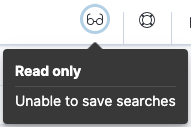
If you don’t have sufficient privileges to save Discover sessions, the following indicator is displayed and the Save button is not visible. For more information, refer to Granting access to Kibana.
By default, a Discover session stores the query text, filters, and current view of Discover, including the columns and sort order in the document table, and the data view.
- Once you’ve created a view worth saving, select Save in the application menu. A modal with several options opens:
- Enter a Title for the session, and optionally a Description and Tags.
- If the session is time-based, turn on Store time with Discover session to save the current time filter and refresh interval with it.
-
Under Add to dashboard, select Existing to add the session as a panel on a dashboard you choose, New to add it to a brand-new dashboard, or None to save the session to the library only.
- Select Save.
- To reload your search results in Discover, select Open in the application menu, and select the saved Discover session.
If the saved Discover session is associated with a different data view than is currently selected, opening the saved Discover session changes the selected data view. The query language used for the saved Discover session is also automatically selected.
- In Discover, open the Discover session that you want to duplicate.
- In the application menu, click Save.
- Give the session a new name.
- Turn on Save as new Discover session.
- Click Save.
- Go to Dashboards.
- Open or create the dashboard, then click Edit.
- Click Add from library.
- From the Types dropdown, select Discover session.
- Select the Discover session that you want to add, then click X to close the list.
If the Discover session contains multiple tabs, you can choose which tab the panel displays.
Open the panel menu and select Edit.
From the tab selector, select the tab you want to display.
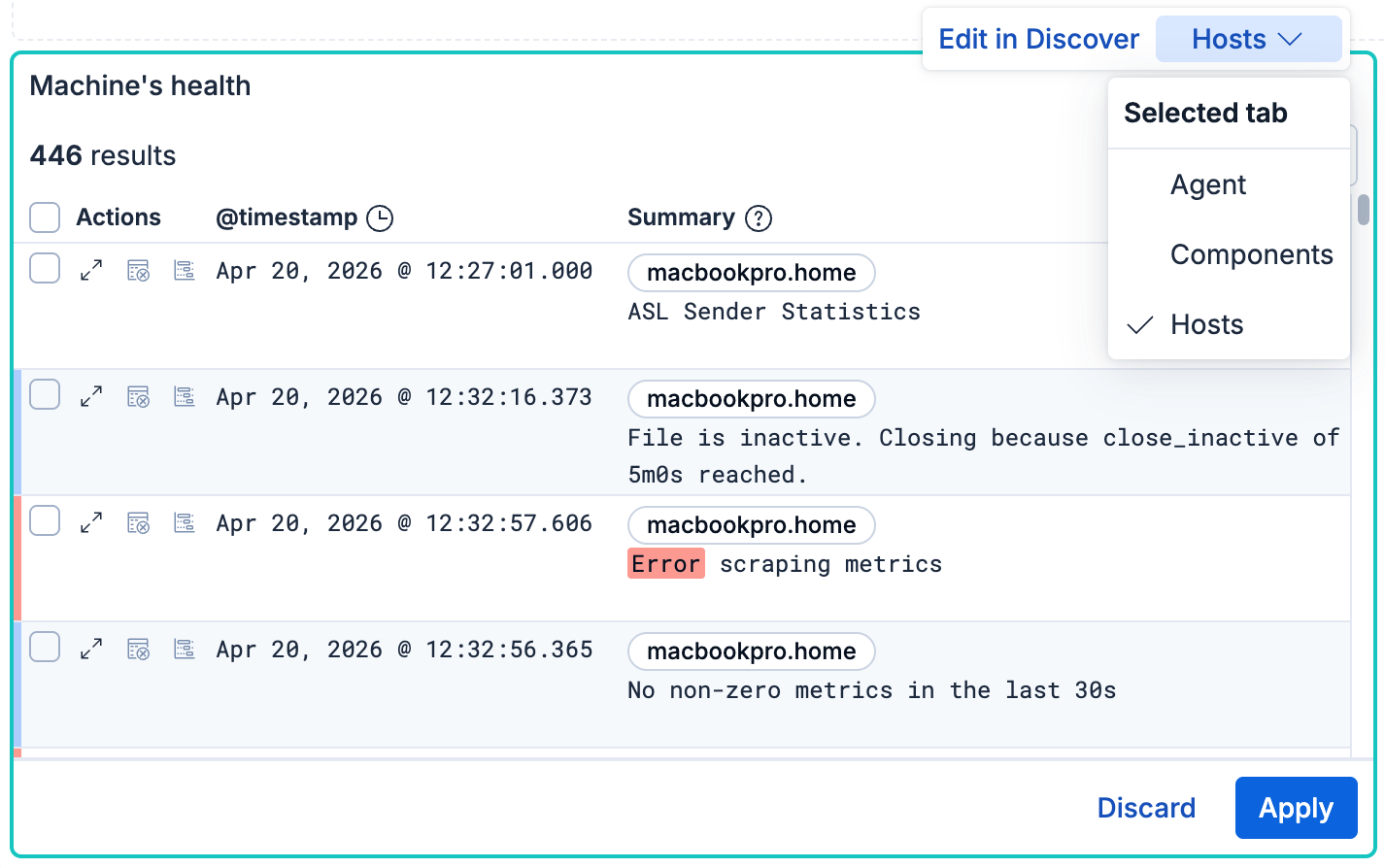
Select Apply.
When editing a Discover session panel from a dashboard, you can save your changes as a new Discover session instead of updating the panel. This works whether the panel was added from the library or created directly on the dashboard.
From the dashboard, hover over the panel and select Edit Discover session configuration.
Make your changes in Discover.
In the application menu, open the menu next to Save and return and select Save as.
In the Save Discover session modal, enter a Title for the new session, and optionally a Description and Tags.
In Add to dashboard, choose where to display the new session:
Existing: Add the new session to a dashboard you select.
- If you select the dashboard the panel came from, the original panel is updated in place to reference the new session, in the same position. If the replaced panel was linked to the library, you can still find it unchanged in the library. If the panel wasn't linked to the library, it is lost and replaced by the newly saved session.
- If you select a different dashboard, the original panel is unchanged, and the new session is added as a separate panel on the dashboard you selected.
New: Save the session and add it as a panel on a new dashboard. The original panel is unchanged.
None: Save the session to the library only, without adding it to a dashboard. The original panel is unchanged.
Select Save and add to library (when None is selected) or Save and go to Dashboard (when Existing or New is selected).
Upon saving, you navigate to the new session in Discover when you selected None, or to the corresponding dashboard when you selected Existing or New.