Add filter controls
Controls are interactive panels that you add to your dashboards to help future viewers filter and display only the data they want to explore more efficiently. Controls apply filters to relevant panels to focus on specific data segments without writing filtering queries.
Pinned control: Appears in the dashboard's sticky header and apply to the whole dashboard. Unpinned control: Lives in the dashboard body; when a control is inside a collapsible section, its filters apply only to panels within that section. Controls outside sections (or pinned) have global scope. Refer to Organize dashboard panels for how section placement affects filter scope.
To add controls to a dashboard, you need:
- All privilege for the Dashboard feature in Kibana
- An existing dashboard open in Edit mode
- A data view configured with fields available for filtering
There are three types of controls:
Options list — Adds a dropdown that allows to filter data by selecting one or more values. For example, if you are using the [Logs] Web Traffic dashboard from the sample web logs data, you can add an options list for the
machine.os.keywordfield that allows you to display only the logs generated fromosxandiosoperating systems.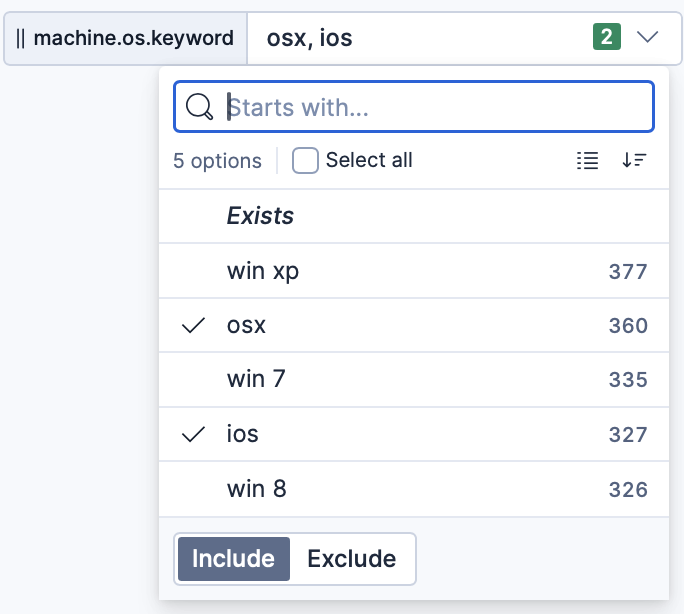
Range slider — Adds a slider that allows to filter the data within a specified range of values. This type of control only works with numeric fields. For example, if you are using the [Logs] Web Traffic dashboard from the sample web logs data, you can add a range slider for the
hour_of_dayfield that allows you to display only the log data from 9:00AM to 5:00PM.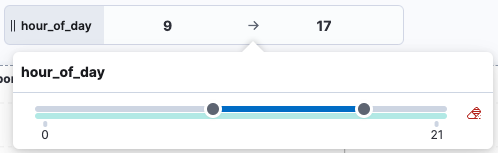
Time slider — Adds a time range slider that allows to filter the data within a specified range of time, advance the time range backward and forward by a unit that you can define, and animate your change in data over the specified time range. For example, you are using the [Logs] Web Traffic dashboard from the sample web logs data, and the global time filter is Last 7 days. When you add the time slider, you can select the previous and next buttons to advance the time range backward or forward, and select the play button to watch how the data changes over the last 7 days.
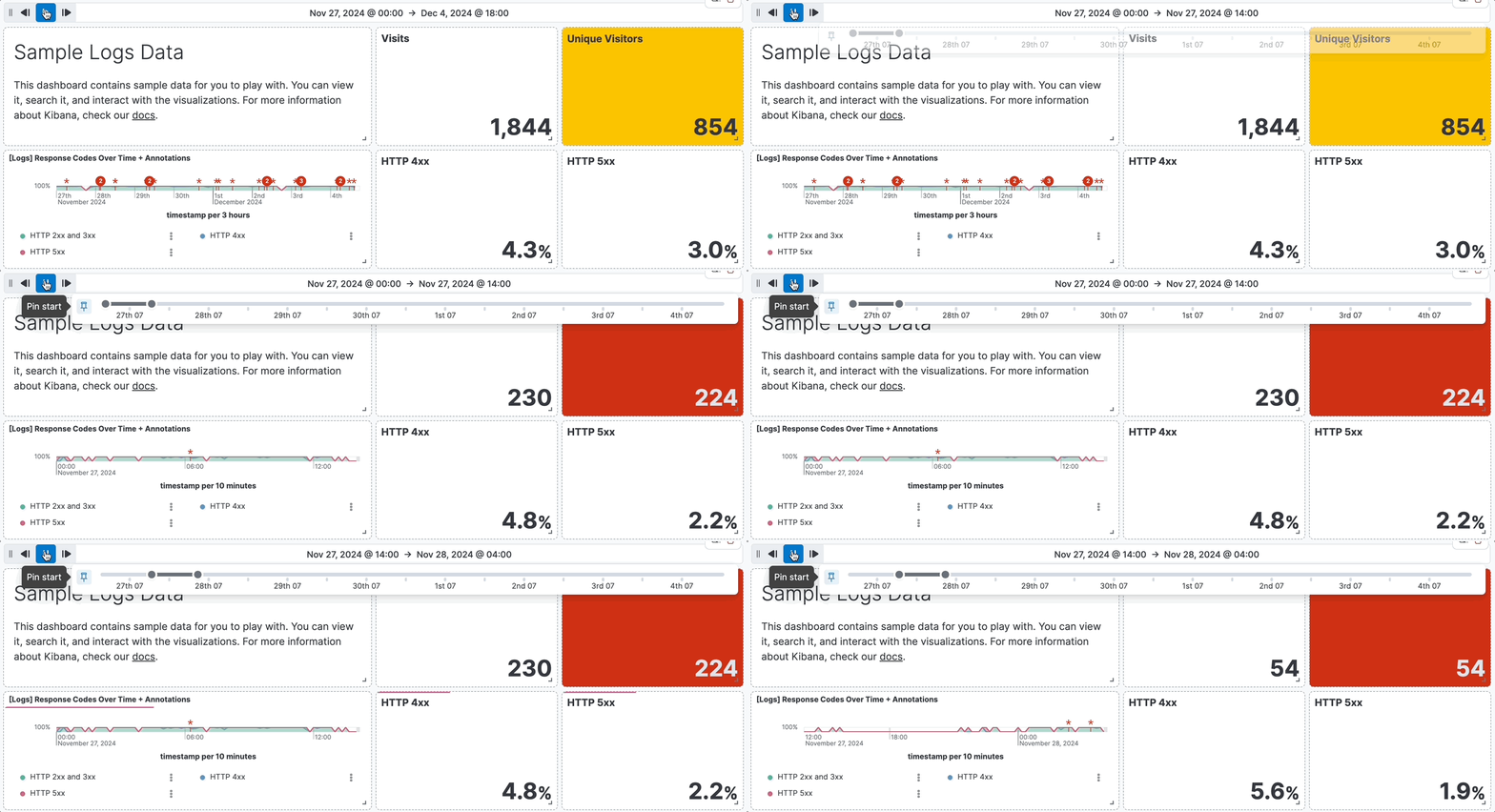
To add interactive Options list and Range slider controls, create the controls, then add them to your dashboard.
Open or create a new dashboard.
Add a control.
- Add as pinned control: In Edit mode, select Add > Controls > Control. The control is pinned and applies to the whole dashboard.
- Add as free panel: Select Add new panel > Controls, then place the control on the dashboard. If you place a control inside a collapsible section, its filters apply only to panels in that section. To move a control between the header and the dashboard body, open the control's panel menu and select Pin to top or Unpin.
In Edit mode, select Add > Controls > Control in the toolbar. In Edit mode, select Controls > Add control in the dashboard toolbar. On the Create control flyout, from the Data view dropdown, select the data view that contains the field you want to use for the Control.
In the Field list, select the field you want to filter on.
Under Control type, select whether the control should be an Options list or a Range slider.
TipRange sliders are for Number type fields only.
Define how you want the control to appear.
For Options lists:
- Label: Overwrite the default field name with a clearer and self-explanatory label.
Selections: Select multiple values to filter with the control, or only one.
Additional settings:
- Use global filters: A panel-level setting that applies to each individual control. It is enabled by default.
- Validate user selections: Highlight control selections that result in no data.
- Ignore timeout for results: Wait to display results until the list is complete.
Label: Overwrite the default field name with a clearer and self-explanatory label.
Minimum width: Specify how much horizontal space does the control should occupy. The final width can vary depending on the other controls and their own width setting.
Expand width to fit available space: Expand the width of the control to fit the available horizontal space on the dashboard.
Selections: Select multiple values to filter with the control, or only one.
Additional settings:
- Ignore timeout for results: Delays the display of the list of values until it is fully loaded. This option is useful for large data sets, to avoid missing some available options in case they take longer to load and appear when using the control.
For Options list controls on string and IP address type fields, you can define how the control’s embedded search should behave:
- Prefix: Show options that start with the entered value.
- Contains: Show options that contain the entered value. This setting option is only available for string type fields. Results can take longer to show with this option.
- Exact: Show options that are an exact match with the entered value.
The search is not case sensitive. For example, searching for
ioswould still retrieveiOSif that value exists.
For Range sliders:
- Label: Overwrite the default field name with a clearer and self-explanatory label.
- Step size: Determine the slider's number of steps. The smaller a slider's step size, the more steps it has.
- Additional settings:
- Use global filters: A panel-level setting that applies to each individual control. It is enabled by default.
- Validate user selections: Highlight control selections that result in no data.
- Label: Overwrite the default field name with a clearer and self-explanatory label.
- Minimum width: Specify how much horizontal space does the control should occupy. The final width can vary depending on the other controls and their own width setting.
- Expand width to fit available space: Expand the width of the control to fit the available horizontal space on the dashboard.
- Step size: Determine the slider's number of steps. The smaller a slider's step size, the more steps it has.
Select Save. The control can now be used.
Consider control order when you have several controls.
A change in one control will impact all other controls on the dashboard, regardless of their positioning in the grid, including pinned controls. The only exception to this is controls within a collapsible section. These controls will only chain with other controls in their section. To change this default behaviour, turn off the Use global filters setting. Controls are applied from left to right; when the Chain controls setting is enabled, their position changes the options available in the next control. Save the dashboard.
In versions 9.0 and 9.1, variable controls are called ES|QL controls.
You can bind controls to your ES|QL visualizations in dashboards. When creating an ES|QL visualization, the autocomplete suggestions prompt control insertion for field values, field names, function configuration, and function names. ES|QL controls act as variables in your ES|QL visualization queries.
A control's filter scope depends on where you place it: controls inside a collapsible section apply only to panels in that section, while controls outside sections or pinned to the dashboard apply to all panels.
Only Options lists are supported for ES|QL-based controls. Options can be:
- values or fields that can be static or defined by a query
-
functions
While you edit your ES|QL query, the autocomplete menu suggests adding a control when relevant or when you type
?in the query. Select Create control.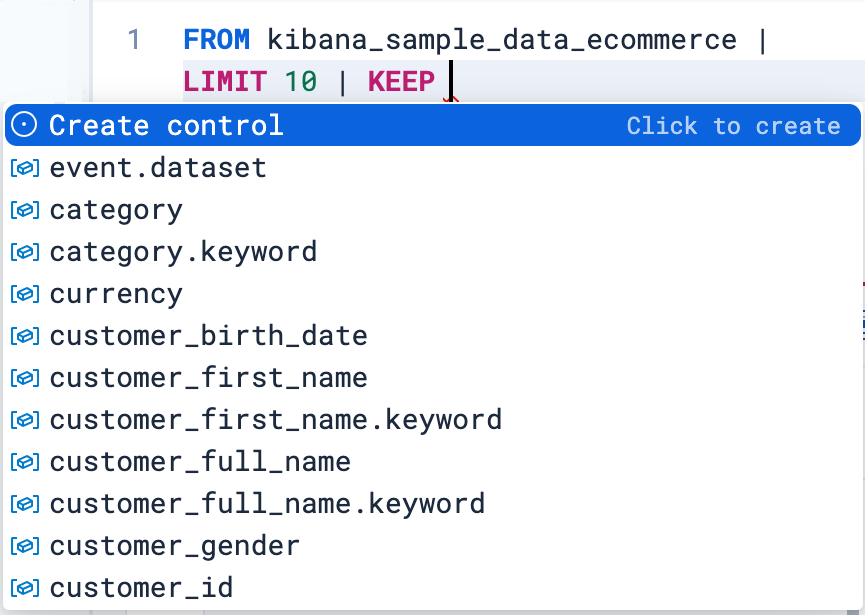
A menu opens to let you configure the control. This is where you can specify:
- The type of the control.
- For controls with Static values, enter available controls manually or select them from the dropdown list.
- For controls with Values from a query, write an ES|QL query to populate the list of options. This option is useful for dynamically retrieving control values or perform advanced actions such as defining chaining controls.
Tip - Only display values available for the selected time range
By linking the control to the global time range, the control only shows values that exist within the time range selected in the dashboard or Discover session. You can do that by specifying
WHERE @timestamp <= ?_tend AND @timestamp > ?_tstartin the control's query, or custom time parameters if your indices don't have a@timestampfield.
- The name of the control. You use this name to reference the control in ES|QL queries.
- Start the name with
?if you want the options to be simple static values. -
Start the name with ??if you want the options to be fields or functions.
- Start the name with
- The values users can select for this control. You can add multiple values from suggested fields, or type in custom values. If you selected Values from a query, you must instead write an ES|QL query at this step.
- The label of the control. This is the label displayed in Discover or in the dashboard.
-
Whether the control should allow selecting a single value or multiple values. This requires using the MV_CONTAINSfunction in your query.
- The type of the control.
Save the control.
The variable is inserted into your query, and the control appears.
If you added it by starting from a query, the control is directly inserted in that query and you can continue editing it. You can then insert it in any other ES|QL visualization queries by typing the control's name.
You can also create variable controls to add later to any query by selecting Add > Controls > Variable control in the dashboard's toolbar.
Examples
Integrate filtering into your ES|QL experience
| WHERE field == ?valueFields in controls for dynamic group by
| STATS count=COUNT(*) BY ??fieldVariable time ranges? Bind function configuration settings to a control
| BUCKET(@timestamp, ?interval),Make the function itself dynamic
| STATS metric = ??function
You can create controls that let users select multiple values. To do that:
Add the
MV_CONTAINSfunction to your query, and create a variable as one of its parameters. For example:FROM logs-* | WHERE MV_CONTAINS(?values, field)NoteMulti-selection is only available for
?valuesvariables. It is not available for??fieldsand??functionsvariables.When defining the control, select the Allow multiple selections option.
Save the control.
The newly configured control becomes available and allows users to select multiple values.
You can set up variable controls in such a way that the selection of one control determines the options available for another control.
This allows you to narrow down control selections dynamically without affecting the entire dashboard, which is especially useful when working with data from multiple indices or when you need hierarchical filtering.
To chain variable controls, you reference one control's variable in another control's ES|QL query using the ?variable_name syntax.
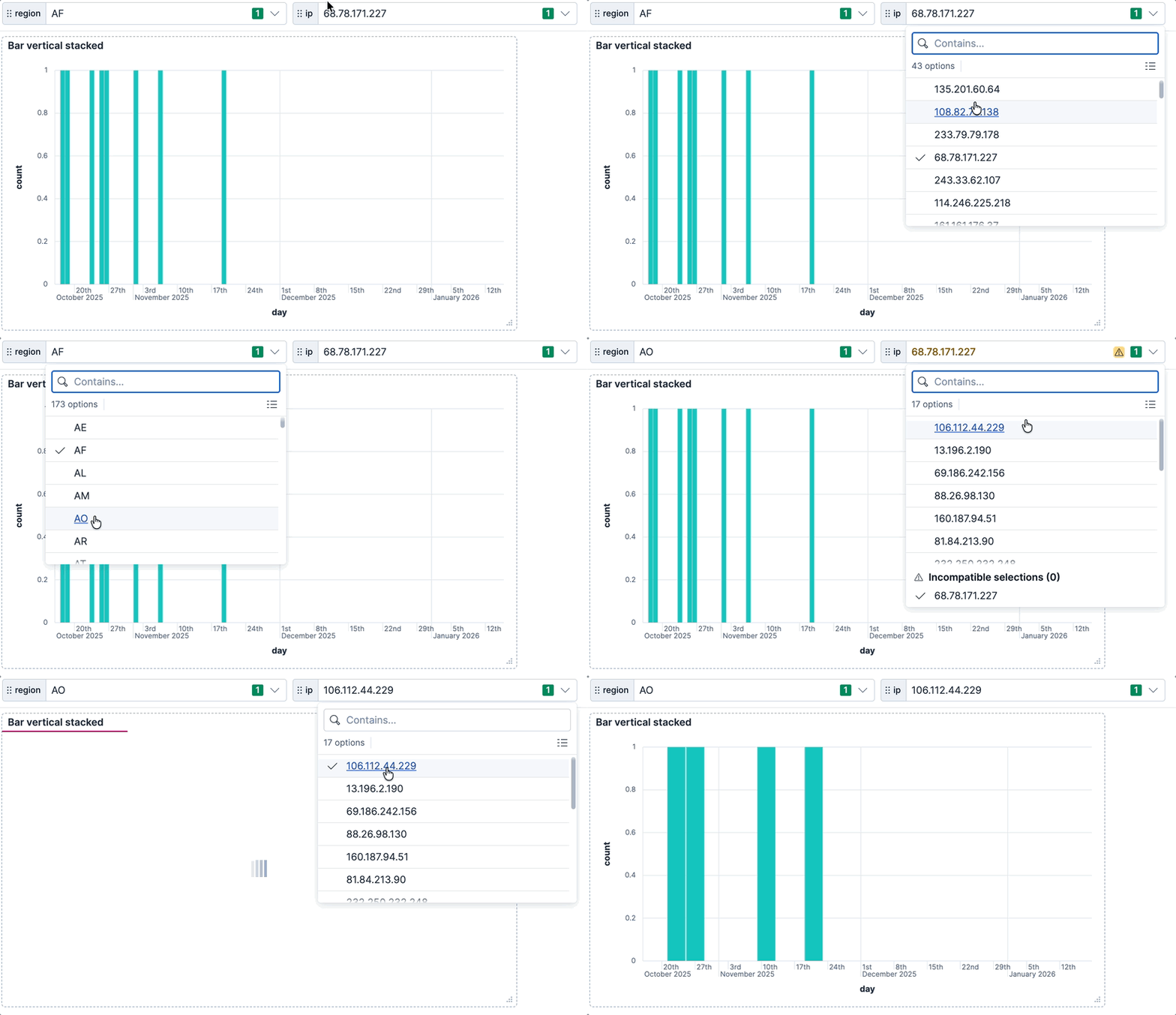
Example: You create a dashboard that analyzes web traffic by region and IP address. Next, you want to see only the IP addresses that are active in a selected region, and then analyze traffic patterns for a specific IP, all without filtering the entire dashboard by region.
Create the first control that will be referenced in other controls.
TipCreate the controls that will be referenced in other controls first. This allows the ES|QL editor to provide proper autocomplete suggestions.
In Edit mode, select Add > Controls > Variable control in the toolbar, then define the control:
- Type: Values from a query
- Query:
FROM kibana_sample_data_logs | WHERE @timestamp <= ?_tend AND @timestamp > ?_tstart | STATS BY geo.dest - Variable name:
?region - Label: Region
This control extracts all unique destination regions from your logs.
Create the second control that depends on the first control.
Add another variable control:
- Type: Values from a query
- Query:
FROM kibana_sample_data_logs | WHERE @timestamp <= ?_tend AND @timestamp > ?_tstart AND geo.dest == ?region | STATS BY ip - Variable name:
?ip - Label: IP address
This control references the
?regionvariable and the built-in time range variables (?_tstartand?_tend). The available IP addresses will be only those associated with the selected region.Test the chained controls. Both controls are now visible on your dashboard. Select different values in the Region control and observe how the available IP addresses in the IP address control change to show only IPs from that region.
Create an ES|QL visualization that uses the
?ipcontrol to filter data. For example:FROM kibana_sample_data_logs | WHERE ip == ?ip | STATS count = COUNT(*) BY day = DATE_TRUNC(1 day, @timestamp) | SORT dayThis visualization filters data based on the selected IP address, while the IP address options themselves are filtered by the selected region.
When you select a value in a parent control, the child control's query reruns automatically. If the currently selected value in the child control is no longer available in the new result set, it is marked as invalid or incompatible.
To add the results of your Discover explorations to a dashboard in a way that preserves the controls created from Discover and also adds them to the dashboard, you have two methods:
Method 1: Adding the Discover session's results
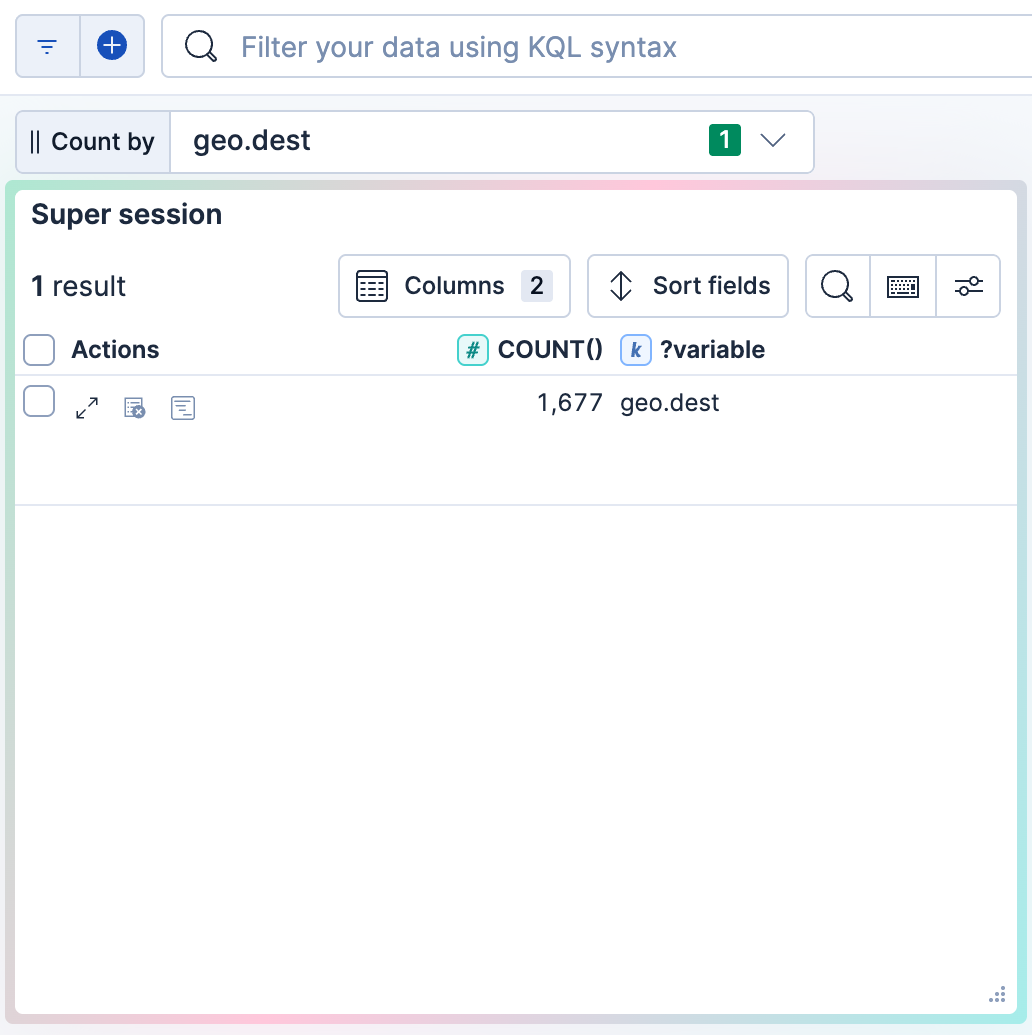
This method allows you to add the result table of your Discover ES|QL query to any dashboard.
Save the ES|QL query containing the variable control into a Discover session. If your Discover session contains several tabs, only the first tab will be imported to the dashboard.
Go to Dashboards and open or create one.
Select Add, then From library.
Find and select the Discover session you saved earlier.
A new panel appears on the dashboard with the results of the query along with any attached controls.
Method 2: Adding the Discover visualization
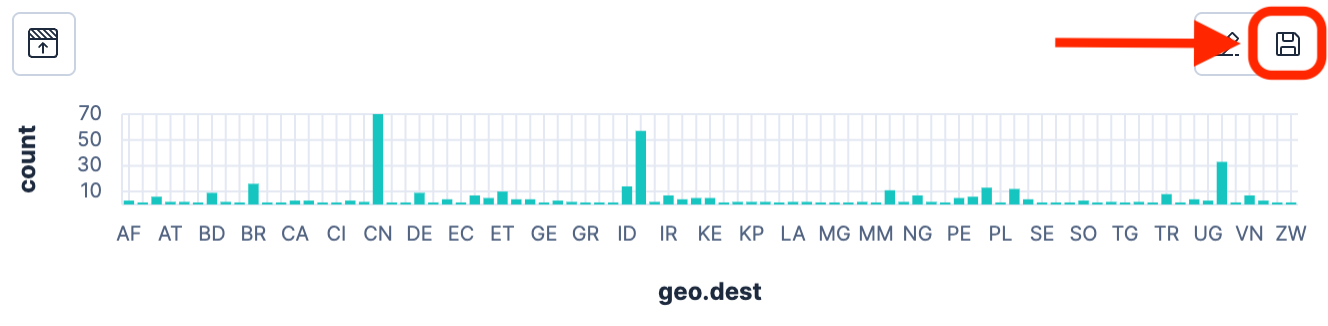
This method allows you to add the visualization of your Discover ES|QL query to any dashboard.
Next to the Discover visualization, select Save visualization.
Select the dashboard to add the visualization to. You can choose an existing dashboard or create one.
The selected dashboard opens. It now includes a new panel that shows the visualization imported from Discover. Existing controls from the initial query in Discover are also added. You can find them at the top of the dashboard.
You can add one interactive time slider control to a dashboard.
Open or create a new dashboard.
Add a time slider control.
-
In Edit mode, select Add > Controls > Time slider control in the toolbar. -
In Edit mode, select Controls > Add time slider control.
-
The time slider control uses the time range from the global time filter. To change the time range in the time slider control, change the global time filter.
Save the dashboard. The control can now be used.
Controls are always chained. Each control narrows the options available in other controls.
For pinned controls, you can click the Settings icon on control to customize the display settings:
Minimum width: Specify how much horizontal space does the control should occupy. The final width can vary depending on the other controls and their own width setting.
Expand width to fit available space: Expand the width of the control to fit the available horizontal space on the dashboard.
Auto apply filters. When enabled (default), the dashboard updates as soon as options are selected in controls. When disabled, you must click the unified search Apply button to apply pending control selections. The Auto apply filters option is available from the Dashboard settings panel.
Configure the control settings.
-
In Edit mode, select Add > Controls > Settings in the toolbar. -
In Edit mode, select Controls > Settings.
-
On the Control settings flyout, configure the following settings:
Label position — Specify where the control label appears.
Filtering settings:
- Apply global filters to controls — Define whether controls should ignore or apply any filter specified in the main filter bar of the dashboard.
- Apply global time range to controls — Define whether controls should ignore or apply the main time range specified for the dashboard. Note that time slider controls rely on the global time range and don’t work properly when this option is disabled.
Selections settings:
- Validate user selections — When selected, any selected option that results in no data is ignored.
- Chain controls — When selected, controls are applied sequentially from left to right, and line by line. Any selected options in one control narrows the available options in the next control.
- Apply selections automatically — The dashboard is updated dynamically when options are selected in controls. When this option is disabled, users first need to Apply their control selection before they are applied to the dashboard.
To remove all controls from the dashboard, select Delete all.
Select Save to apply the changes.
Change the settings for Options list and Range slider controls.
- Hover over the control you want to edit, then select
 .
. - In the Edit control flyout, change the options, then select Save and close.
To remove a control from view without deleting it, use Unpin from the control's panel menu; the control moves into the dashboard body. To remove it from the dashboard entirely, click Remove from the control's menu.
- Hover over the control you want to delete, then select
 .
. - In the Delete control? window, select Delete.
If you delete a variable control that's used in an ES|QL visualization, the visualization will break. You must edit the visualization query and remove or update the control reference.