Release a bug fix for supporting older package version
Sometimes, when we drop the support for an earlier version of the stack and later on find out needing to add a bug fix to some old package version, we have to make some manual changes to release the bug fix to users. For example: in this PR (AWS package version 1.23.4), support for Kibana version 7.x was dropped and bumped the AWS package version from 1.19.5 to 1.20.0. But we found a bug in the EC2 dashboard that needs to be fixed with Kibana version 7.x, so instead of adding a new AWS package version 1.23.5, we need to fix it between 1.19.5 and 1.20.0. This means creating a new version (for example, 1.19.6) based on 1.19.5.
Overview of the process:
- Find the git commit that introduced the target package version.
- Open a PR adding a new entry to
.backports.yml— CI validates and dry-runs the branch creation, and the branch is created automatically on merge. - Create a PR with the bug fix against that backport branch.
- Update the changelog in
mainto include the new version.
Detailed steps:
Find the git commit for the target package version
In the example above, the commit to be fixed is the one right before this PR updating package
aws:Using the web:
Look for the merge commit of the PR
- https://github.com/elastic/integrations/commit/aa63e1f6a61d2a017e1f88af2735db129cc68e0c
- It can be found as one of the last messages in the PR

- And then show the previous commits for that changeset inside the package folder (e.g.
packages/aws): - https://github.com/elastic/integrations/commits/aa63e1f6a61d2a017e1f88af2735db129cc68e0c/packages/aws/
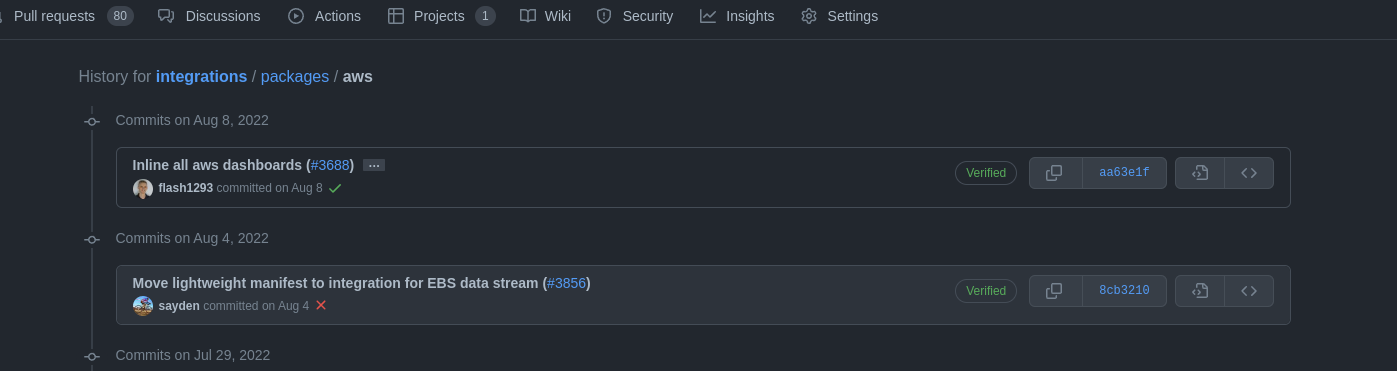
Using the command line:
Using the helper script
dev/scripts/get_release_commit.sh, which finds the commit directly from the package name and version:Syntax:
./dev/scripts/get_release_commit.sh -p <package_name> -v <version>Example:
$ ./dev/scripts/get_release_commit.sh -p aws -v 1.19.5
8cb321075afb9b77ea965e1373a03a603d9c9796
Alternatively, using
git log:Syntax:
git log --grep "#<pr_id>" -- packages/<package_name>
git log -n 1 <merge_commit>^ -- packages/<package_name>
Example:
$ git log --grep "#3688" -- packages/aws
commit aa63e1f6a61d2a017e1f88af2735db129cc68e0c
Author: Joe Reuter <xx@email.de>
Date:   Mon Aug 8 17:14:55 2022 +0200

    Inline all aws dashboards (#3688)

    * inline all aws dashboards

    * format

    * apply the right format

    * inline again

    * format
$ git log -n 1 aa63e1f6a61d2a017e1f88af2735db129cc68e0c^ -- packages/aws
commit 8cb321075afb9b77ea965e1373a03a603d9c9796
Author: Mario Castro <xx@gmail.com>
Date:   Thu Aug 4 16:52:06 2022 +0200

    Move lightweight manifest to integration for EBS data stream (#3856)
Add a new entry to
.backports.ymland open a PRThe backport branch is created automatically when a new entry is merged into
.backports.yml.Recommended: use the
AddBackportEntrymage targetThis target resolves the base commit automatically (combining steps 1 and 2) and inserts the entry in the correct position in the file:
mage AddBackportEntry <package_name> <base_version>Example:
$ mage AddBackportEntry aws 1.19.5
Added: branch=backport-aws-1.19 base_commit=8cb321075afb9b77ea965e1373a03a603d9c9796
Alternatively: add the entry manually
Open a PR adding the entry for the branch you need:
- package: <package_name>
  branch: backport-<package_name>-<major>.<minor>
  base_version: "<version>"
  base_commit: "<commit_from_step_1>"
  maintained_until: null
  archived: false
Example for the
awspackage at version1.19.5:- package: aws branch: backport-aws-1.19 base_version: "1.19.5" base_commit: "8cb321075afb9b77ea965e1373a03a603d9c9796" maintained_until: null archived: falseFields:
package— package name as defined in thenamefield ofmanifest.ymlbranch— name of the backport branch to create, following the formatbackport-<package_name>-<major>.<minor>base_version— the package version to branch from (e.g.1.19.5,1.0.0-beta1)base_commit— the commit SHA found in the previous stepmaintained_until— set to aYYYY-MM-DDdate if the branch has a known end-of-life, otherwisenullarchived— set tofalsefor a new active branch
Once the PR is opened, CI automatically:
- Validates the new entry schema (
check-backports-inventory) - Runs a dry run of the branch creation, which verifies that the package is published, the commit exists, the commit publishes the expected version, and the branch does not already exist — without pushing anything
The PR requires review from the
elastic/ecosystemteam (they are the CODEOWNERS of.backports.yml). Once merged tomain, the branchbackport-<package_name>-<major>.<minor>is created and pushed automatically. A comment is posted on the merged PR confirming success or failure of the branch creation.Create a PR for the bug fix
Create a new branch in your own remote (it is advised not to use a branch name starting with
backport-), and apply bugfixes there. Remember to update the version in the package manifest (update patch version like1.19.<x+1>) and add a new changelog entry for this patch version.Once ready, open a PR selecting as a base branch the one created above:
backport-<package_name>-<major>.<minor>(e.g.backport-aws-1.19).Once this PR is merged, this new version of the package is going to be published automatically following the usual CI/CD jobs. Wait for the package to appear in the Elastic Package Registry before proceeding to the next step.
If it is needed to release a new fix for that version, there is no need to create a new branch. Just create a new PR to merge a new branch onto the same backport branch created previously.
Update changelog in main
Once PR has been merged in the corresponding backport branch (e.g.
backport-aws-1.19) and the package has been published, a new Pull Request should be created manually to update the changelog in the main branch to include the new version published in the backport branch. Make sure to add the changelog entry following the version order.In order to keep track, this new PR should have a reference (relates) to the backport PR too in its description.
Missing
elastic-package stack shellinitin backport branch:Example of the error:
Error: could not create kibana client: undefined environment variable: ELASTIC_PACKAGE_KIBANA_HOST. If you have started the Elastic stack using the elastic-package tool, please load stack environment variables using 'eval "$(elastic-package stack shellinit)"' or set their values manuallySolution: add elastic-package stack shellinit command in
.buildkite/scripts/common.sh.eval "$(elastic-package stack shellinit)"
License file not found in backport branch:
Example of the error:
Error: checking package failed: building package failed: copying license text file: failure while looking for license "licenses/Elastic-2.0.txt" in repository: failed to find repository license: stat /opt/buildkite-agent/builds/bk-agent-prod-gcp-1703092724145948143/elastic/integrations/licenses/Elastic-2.0.txt: no such file or directorySolution: Remove line defining
ELASTIC_PACKAGE_REPOSITORY_LICENSEenvironment variable.